|
|
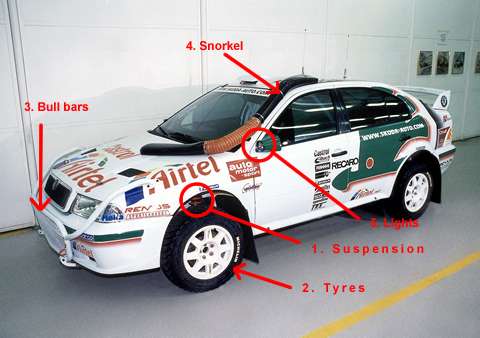
Safari Rally is such a specialized event that teams prepared special cars to cope with the conditions. Specifications varied from time to time, our example is Skoda Octavia that contested Safari Rally in 2000.
|
Ride height of the car is noticeably higher than on a normal gravel rally car. This makes car more nervous as chassis tends to roll more but corners are such a scarcity that this is not a major problem.
Spring and damper settings are much harder than normal and have been reinforced to withstand long and rough stages.
|
Special tyres have been prepared to withstand rock-strewn stages. Much stronger than ordinary gravel tyres with thicker sidewalls and strengthened internal construction.
Due to high speeds and temperatures, anti-puncture technologies are not feasible option in Safari which Peugeot found out the hard way in 2000. Driver's ability to avoid punctures has been paramount and Richard Burns managed to win the event in 2000 without having single puncture!
|
The most visible of external protection added to the cars is the bull bar. Its purpose is to fend off damage to front of car in case of collision with wildlife. Or other objects, drivers have retired after having collided with matatu, local busses crawling along the roads.
Bull bars are not the only external protection, most cars have extra under-side protection added too. Despite higher rideheight the high speeds mean that more rocks are thrown up.
|
The need for snorkel has varied from time to time depending on time of the year and local weather conditions. Snorkel allows engine to get air even when fording deep rivers.
|
Mounted on door mirrors are extra high-energy discharge lights. These are kept on at all times and are much brighter than ordinary headlights. Their purpose is to make car more visible to others even when travelling in dust cloud.
|
Other changes include larger fuel tank to allow for longer distances, both in competitive and road sections. To combat scorching sun cars have had completely mirror-coated side and rear windows.
Often some of the most recent and high-tech solutions have been dropped from Safari spec cars as reliability is the primary concern. For example Toyota Corolla WRC was not fitted with electronic gearshift TTE used in other events.
Cars can carry two spare wheels and often have extra tools and spare parts onboard. This combined with added weight from strengthening of the car means that Safari specification cars were well over the minimum weight limit. In late 1990's extra weight amounted about 200 kg.
|
|
 |
Safari spec Octavia WRC
 |
|